How to Animate Game Characters with Text Prompts
How text-to-animation works for game characters, how to write motion prompts that look natural, and how it compares to keyframing, mocap and Cascadeur.
 Sai VedaCo-founder, ZeroAtoms3 min read
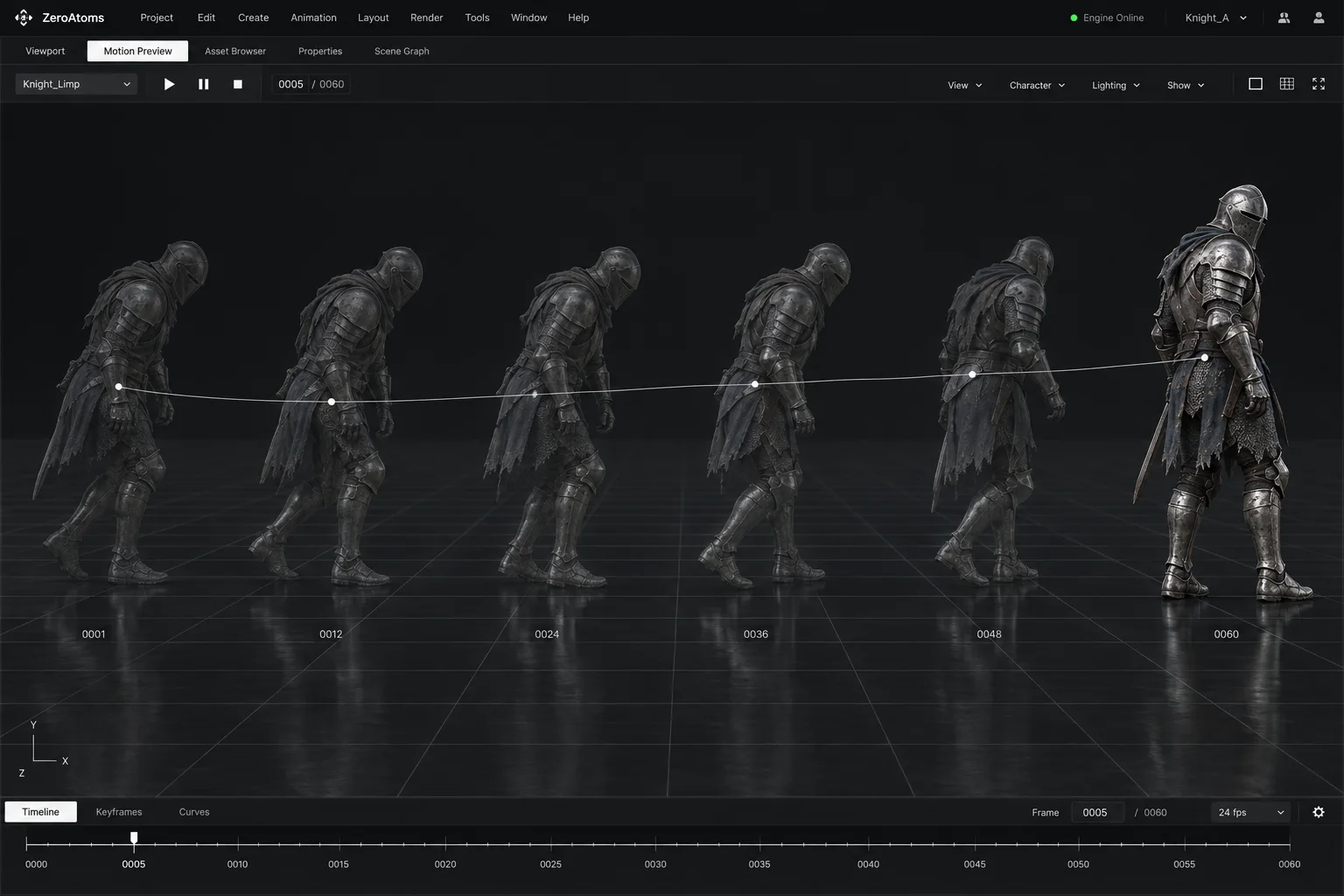
Short answer: with text-to-animation, you describe a movement ("limp forward favoring the left leg, then look back") and the engine generates it on your character's skeleton. It works best when you write in short beats, say how heavy and how emotional the movement is, and let the engine handle foot contact and physics. Then you adjust by hand where it matters.
Four ways to animate a game character
| Method | How it works | Good for | Cost and effort |
|---|---|---|---|
| Keyframing | An animator poses the character frame by frame | Stylized motion, full control | Slow; needs a skilled animator |
| Motion capture | Record a real performer and map it to the rig | Realistic human movement | Studio or suit costs, plus cleanup |
| AI-assisted keyframing | Tools like Cascadeur add physics and auto-posing to keyframes | Faster keyframing with believable weight | Still needs animation skill |
| Text-to-animation | Describe the motion; the engine generates it | Fast iteration, small teams, many actions | Minutes per action, then refine |
Markerless capture tools such as Move AI record motion from ordinary video, and Rokoko offers capture suits and video tools. Mixamo provides a library of ready-made motions and an auto-rigger. In ZeroAtoms, text direction is built into the animation timeline, and you can bring in captured or library motion alongside it.
How text-to-animation works, briefly
- Your description becomes a sequence of actions. "Walk in wounded, stop, look back" turns into three clips on a timeline.
- A motion model generates the body movement for each action, matched to your character's proportions.
- The engine grounds it. Foot IK keeps feet planted on uneven ground, physics blending adds weight, and contacts like "catch the railing" pin a hand to an object.
- It stays editable. The text stays on the timeline. Change a word and regenerate, or edit the curves directly.
How to write a motion prompt that looks natural
Generic prompts produce generic motion. Specific prompts produce acting.
1. One beat per clip. Split long actions into steps.
- Weak: "the knight walks to the edge and looks around and then sits down tired"
- Better: "walk to the edge, slow and heavy" / "stop and scan the valley" / "sit down on the stone, exhausted"
2. Say how, not just what. Weight and emotion matter more than the verb.
- "walk" becomes "walk slowly, carrying armor that's too heavy for him"
3. Name the body part when it matters. "Favor the left leg", "hold the right arm against the ribs".
4. Give contacts and targets. "Catch the railing with the right hand", "look at the lighthouse".
5. Add timing when it's important. "Hold the pose for a second before turning."
Common problems and fixes
- Feet slide or float: make sure foot IK and ground adaptation are on, and that the character's scale matches the world.
- Motion looks floaty: increase weight or physics blending, and use words like "heavy", "tired" or "braced".
- The transition between clips pops: add a short linking beat ("shift weight to the right foot") or overlap the clips.
- Hands go through objects: add an explicit contact ("rest the hand on the table").
When to still animate by hand
Signature moves, cutscene close-ups and highly stylized characters often deserve hand polish. Use text-to-animation to block out and cover the long list of everyday actions, then spend animator time on the moments players will remember.
If you're starting a project from scratch, our step-by-step guide to making a 3D game with AI shows where animation fits in.
Frequently asked questions
What is text-to-animation?
Text-to-animation generates character motion from a written description. You describe an action, such as limping across a bridge, and the engine produces the movement on the character’s skeleton, often with foot IK and physics applied.
Is AI animation good enough for games?
For most gameplay actions, yes, especially when it is grounded with foot IK and physics and refined by hand where needed. Hero moments and stylized characters still benefit from an animator’s polish.
Do I need motion capture if I use AI animation?
No, but you can combine them. Many teams generate everyday actions from text and use capture or hand animation for signature moves.
Can AI animation be retargeted to different characters?
Yes. Motion generated for one humanoid skeleton can be retargeted to others with different proportions, which is how one description can drive many characters.
Keep reading
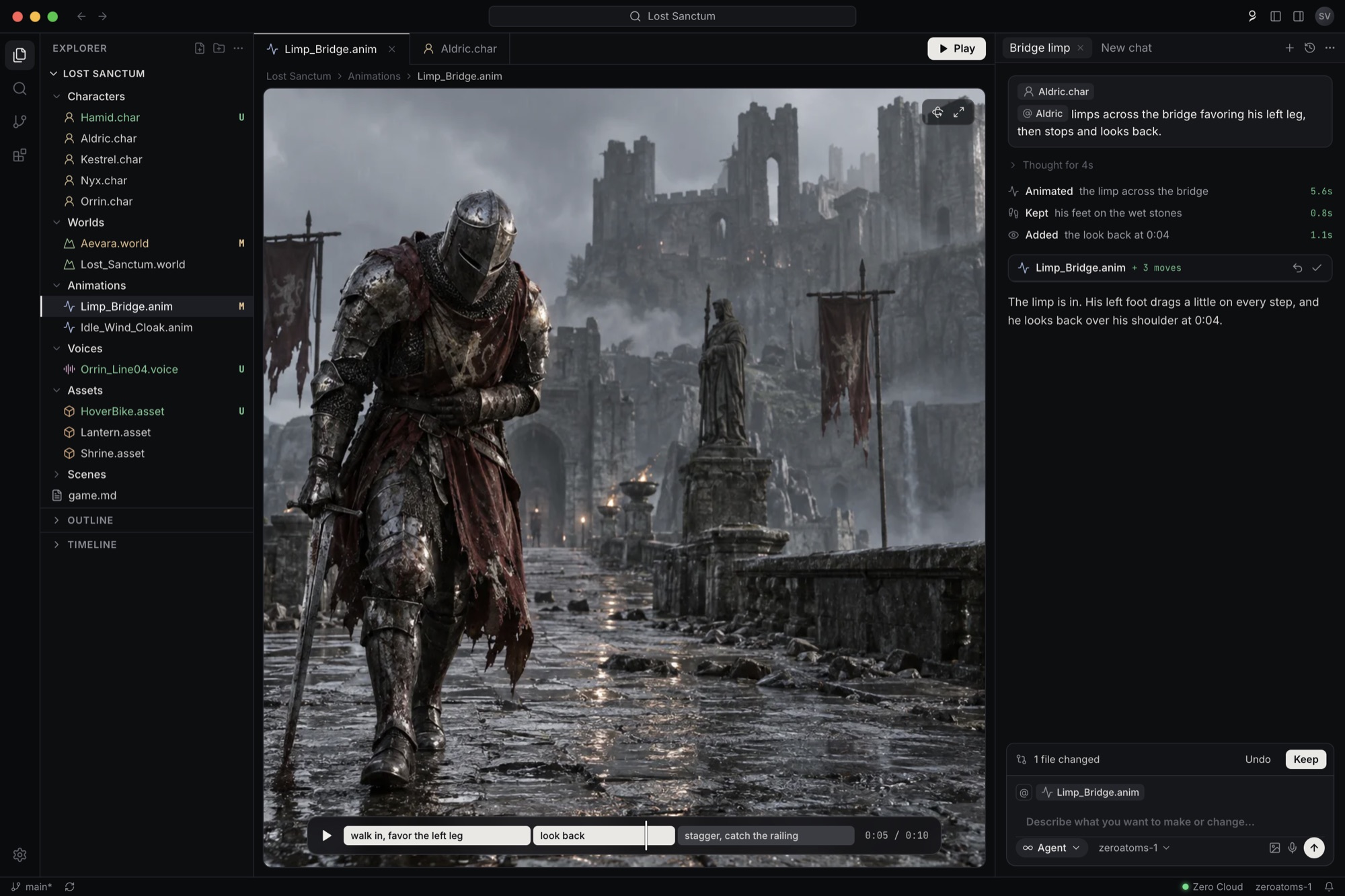 The Best AI Game Makers and Engines in 2026, ComparedAn honest comparison of AI game engines and makers in 2026, including ZeroAtoms, Summer Engine, Rosebud AI, Unity AI, Unreal and Godot, and which fits you.
 How to Make a 3D Game with AI (No Coding Required)Yes, you can build a 3D game with AI and no coding. A step-by-step guide: plan the game, build the world, cast characters, direct animation, add voice, ship.
 Meshy vs Tripo vs Rodin vs Hunyuan3D: AI 3D Models for GamesMeshy, Tripo, Rodin and Hunyuan3D compared for game assets in 2026, plus the checklist that makes an AI-generated 3D model actually game-ready.